What to Do When a Doctor Prescription is Completely Illegible: A 5-Step Patient Safety Protocol
Navigating Unreadable Scripts: The Pharmacist Clarification Call, Statutory Patient Rights, Mobile Health OCR, and How to Prevent Medication Guesswork
Navigating Unreadable Scripts: The Pharmacist Clarification Call, Statutory Patient Rights, Mobile Health OCR, and How to Prevent Medication Guesswork
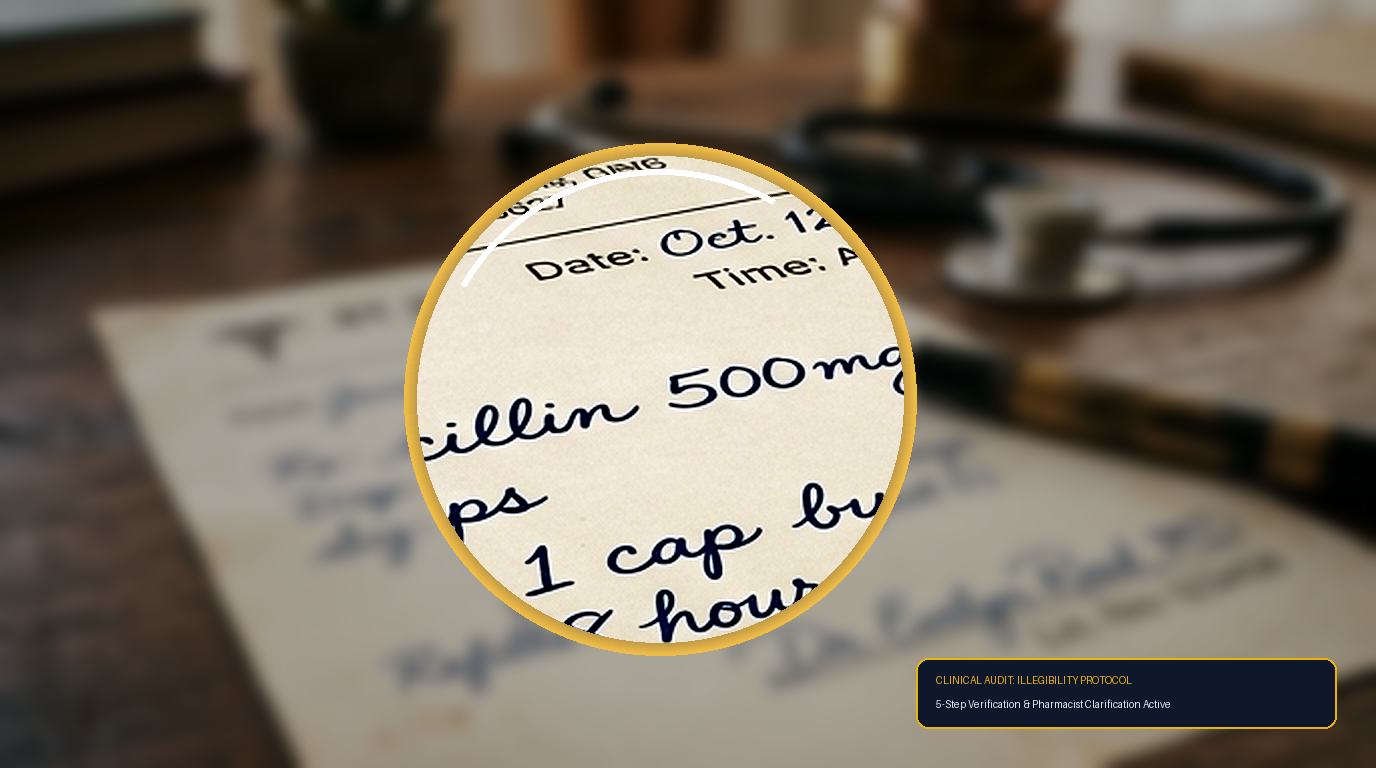
1. The Seismic Wave on Paper: The Danger of Ambiguous Medical Penmanship
You have just spent forty-five minutes waiting in a busy outpatient clinic, followed by a hurried five-minute consultation with a senior physician. The doctor scribbles vigorously across a white prescription blank, tears off the sheet, hands it to you, and rushes to the next patient. You glance down at the paper: instead of recognizable words, the page is covered in wavy horizontal squiggles, overlapping loops, and unidentifiable abbreviations that look more like an earthquake seismograph than clinical therapy.
What should you do? For many patients, embarrassment or intimidation takes over. Nobody wants to feel like a nuisance by interrupting a busy doctor to say, "I cannot read a single word of this." So the patient walks to a local chemist shop, hoping the pharmacist will somehow understand the cryptic markings.
This scenario unfolds millions of times every single day around the globe. Yet medical penmanship is not a trivial joke about bad handwriting—it is a recognized public health hazard. When a prescription cannot be read with 100% certainty, guessing becomes a deadly game of clinical Russian roulette. Here is the definitive 5-step patient safety protocol for handling illegible prescriptions.
2. Why Guessing Is a Fatal Gamble: Real Cases of Illegibility Disasters
To appreciate why absolute legibility is essential, one only needs to examine landmark legal cases in medical malpractice history.
In one infamous American lawsuit, a cardiologist wrote a prescription for "Isordil 20 mg" (an oral nitrate for angina and coronary artery disease) for a patient with heart disease. Because the handwriting was notoriously compressed and sloppy, the community pharmacist misread the cursive word "Isordil" as "Plendil" (a potent calcium channel blocker for hypertension). The patient was dispensed Plendil at four times its maximum recommended therapeutic dose. Within days, the patient collapsed from profound hypotension and acute myocardial infarction, resulting in a fatal outcome. The jury found both the physician and the dispensing pharmacist jointly liable for millions of dollars, citing unreadable handwriting and failure to verify.
Other catastrophic misinterpretations include mistaking "Amoxil" for "Daonil" (an oral anti-diabetic sulfonylurea that triggers fatal hypoglycemia in non-diabetic patients) and misreading decimal points—dispensing 50 mg of a cardiovascular drug instead of 5.0 mg. Ambiguity in healthcare kills.
3. Step 1: The Consultation Room Read-Back (Never Leave the Clinic Blind)
The single most effective moment to intercept an illegible prescription is while you are still standing inside the consultation room with the prescribing doctor. You have a statutory legal and ethical right to understand every detail of your treatment.
Adopt the "Consultation Room Read-Back": Before placing the prescription in your pocket or bag, look directly at the paper in front of the doctor and politely say: "Doctor, could you please read through these medicine names, strengths, and timings with me once to make sure I understand everything?"
As the physician reads aloud, take out your smartphone and type the spoken names and daily schedules into your phone's notes app, or write them neatly in block capital letters in the margins of your personal health notebook. If any word is completely illegible on the slip, ask respectfully: "Could you write this drug name in capital letters so the pharmacist doesn't have any trouble reading it?" No ethical doctor will ever refuse this request.
The Consultation Read-Back
Never walk out of a clinic without hearing your doctor speak each medicine name and timing aloud. Jot down the names in your smartphone notes while the doctor is right in front of you.
4. Step 2: The Pharmacist Duty of Care (Letting the Dispenser Intervene)
If you have already left the medical clinic and find yourself holding an unreadable prescription, your frontline ally is your licensed community pharmacist.
Under pharmaceutical licensing laws and professional codes of ethics, pharmacists have an affirmative "Duty of Care". A pharmacist is legally prohibited from dispensing any medication based on guesswork. If a pharmacist cannot read a prescriber's writing with complete, unambiguous certainty, they are legally mandated to execute the Pharmacist Clarification Protocol.
This means the pharmacy staff will place a telephone call directly to the prescribing doctor's office or hospital department: "Hello, this is Pharmacist Sarah from Green Cross Pharmacy. I am calling to clarify Dr. Smith's prescription for patient John Doe regarding the drug name and milligram strength on line two." Do not be impatient if this clarification takes 15 to 30 minutes; that phone call is a life-saving barrier protecting you from an accidental drug overdose.
5. Step 3: Utilizing Computer Vision and Medical AI Decoders
In our modern digital era, patients have access to advanced clinical technology that was unimaginable a decade ago. Platforms like Theprescription leverage state-of-the-art computer vision models trained specifically on vast corpora of physician cursive and clinical pharmacopeias.
By taking a high-resolution, well-lit photograph of your paper prescription slip with your mobile phone, intelligent ensemble neural networks analyze cursive ligatures, stroke directionality, and terminal loops. Crucially, the AI doesn't just guess random words—it cross-references extracted letter tokens against comprehensive pharmaceutical databases, validating matching drug strengths, approved clinical indications, and typical dosage frequencies.
While AI serves as an educational decision-support tool and does not replace the ultimate judgment of your doctor or pharmacist, it bridges the literacy gap, providing you with a clean, structured preliminary breakdown of what your doctor wrote.
6. Step 4: The Three-Point Counter Cross-Check at the Pharmacy
When the pharmacy technician hands you your dispensed medication bag, perform the "Three-Point Counter Cross-Check" before handing over your credit card or stepping away from the counter:
Point 1: Match the printed bottle label against your notes or the prescription slip. Does the drug name on the bottle match the name your doctor spoke?
Point 2: Verify the indication. Ask the pharmacist directly: "What is this specific tablet treating?" If the pharmacist says, "This is for high blood pressure," and you came in for an acute throat infection, you have instantly caught a dispensing error!
Point 3: Check the pill appearance. If you are refilling a chronic medication and the tablet has changed shape or color, ask for confirmation that it is simply a new generic manufacturer and not a wrong bottle.
The Indication Safety Check
Asking "What does this tablet treat?" at the pharmacy counter is the fastest way to catch a dispensing mix-up before you ever take a pill home.
7. Step 5: Demanding Legibility and Digital EHR Prescriptions
The ultimate long-term solution to physician illegibility is transitioning away from paper prescription pads entirely. Electronic Prescribing (e-Prescribing) systems eliminate handwriting errors by transmitting machine-printed, structured digital orders directly from a clinic computer to the pharmacy dispensary.
Whenever you visit a doctor's office or hospital network, advocate for your health safety: ask if the clinic can send your prescriptions electronically to your preferred pharmacy. If paper is the only option available, politely request a computer-printed clinical summary or printed prescription slip. Transparent, legible communication is the bedrock of modern patient-centered care.
8. The Illegible Prescription Safety Checklist and Action Matrix
Here is the complete step-by-step action plan to follow whenever you encounter an illegible prescription:
In routine clinical practice, active patient engagement represents the single greatest safeguard against preventable medication errors. When individuals take time to review their prescription orders, verify the correct indications, and clarify all ambiguous instructions prior to leaving the medical clinic, treatment adherence improves dramatically while adverse drug reactions decline.
Furthermore, healthcare systems increasingly recognize that health literacy is a cornerstone of effective disease management. Patients who understand the pharmacological rationale behind their dosing schedules, active ingredients, and potential dietary conflicts are far more likely to maintain therapeutic consistency, avoid accidental missed or duplicated doses, and achieve lasting clinical wellness.
Pharmacists and primary care physicians actively welcome constructive dialogue regarding prescription regimens. Never hesitate to voice concerns about side effects, affordability, or formulation preferences. An open, communicative therapeutic alliance between patient and clinician remains the foundation of safe and compassionate modern medicine.
| Location / Phase | Patient Action & Protocol | Key Words to Say | Clinical Safety Benefit |
|---|---|---|---|
| In Doctor Consultation Room | Request verbal read-back; write in phone notes | "Could we review the medicine names and timings together once?" | Zero ambiguity before stepping out of the clinic |
| In Doctor Consultation Room | Request block capital letters if script is messy | "Could you write the drug name in capital letters for the chemist?" | Eliminates cursive ligature misinterpretation |
| At Home / On the Go | Scan prescription using digital health tools | Photograph prescription slip using Theprescription app | Instant preliminary AI breakdown of salts and schedules |
| At the Community Pharmacy | Insist on pharmacist clarification if unclear | "The handwriting is a bit faint; could you verify this with the clinic?" | Activates mandatory pharmacist Duty of Care verification |
| At Pharmacy Checkout | Perform Three-Point Counter Cross-Check | "What is the exact medical indication for this tablet?" | Catches look-alike, sound-alike dispensing errors |
| Future Appointments | Request electronic e-prescribing or printed orders | "Can this prescription be submitted electronically to my pharmacy?" | Eliminates paper handwriting hazards entirely |
Key Clinical Takeaways for Patients
- Never guess or attempt to decipher ambiguous medical handwriting on your own; dispensing guesswork is a primary cause of preventable medication fatalities.
- You have an inviolable statutory right to have your diagnosis, drug names, and dosing schedules explained in plain, legible language before leaving any medical clinic.
- Pharmacists have a mandatory legal duty of care to refuse dispensing any prescription that contains unreadable, ambiguous, or incomplete clinical handwriting.
- The "Pharmacist Clarification Protocol" directly verifies intended therapy with the prescribing physician via secure clinical phone lines before filling orders.
- Modern computer vision and AI transcription tools like Theprescription empower patients to convert messy handwritten scripts into structured digital summaries.
Medical Disclaimer: Medical Disclaimer: This article is published solely for educational, health literacy, and informational purposes. Theprescription is not a certified medical device and does not dispense medical advice. Patients must never alter, stop, or initiate prescription medications without direct clinical consultation with a licensed physician and dispensing pharmacist. Originally published on Theprescription.