Polypharmacy in Older Adults: Managing 5+ Daily Prescriptions and Avoiding Medication Cascades
Deprescribing Pharmacology: The Beers Criteria, Prescribing Cascades, Anticholinergic Burden, and How to Protect Aging Loved Ones from Drug Toxicity
Deprescribing Pharmacology: The Beers Criteria, Prescribing Cascades, Anticholinergic Burden, and How to Protect Aging Loved Ones from Drug Toxicity
1. The Pillbox Explosion: When Medicine Becomes More Dangerous Than Disease
Open the bathroom cabinet or kitchen nightstand of an average seventy-year-old adult, and you will frequently discover an astonishing pharmaceutical assembly: two pills for high blood pressure, one for cholesterol, another for diabetes, a blood thinner, an acid reducer, a sleeping pill, an allergy tablet, a bladder pill, and an over-the-counter pain reliever. In total, eight to twelve distinct pills are swallowed every single day.
In clinical medicine, the concurrent use of five or more routine medications is defined as polypharmacy. While each individual prescription may have been initiated with good intentions by a different clinical specialist (a cardiologist for the heart, a rheumatologist for the joints, an endocrinologist for the pancreas), their cumulative combination often produces a toxic pharmacological web.
As the number of daily medications climbs, the risk of severe drug-drug interactions, accidental falls, cognitive confusion, and emergency hospitalizations skyrockets exponentially. Studies show that a patient taking 5 medications has a 50% probability of an adverse drug interaction; for a patient taking 8 or more medications, the probability approaches 100%! Understanding geriatric pharmacotherapy and learning how to safely "deprescribe" is one of the most vital clinical topics for older adults and their family caregivers.
2. The Aging Body: How Kidneys, Liver, and Body Composition Alter Drug Clearance
Why are older adults so uniquely vulnerable to medication side effects? The root cause lies in the physiological transformations that accompany the natural human aging process.
1. Renal Decline: Glomerular filtration rate (GFR) declines by roughly 1 mL/min/year after age 40. By age 75, an older adult has lost up to 40% of their kidney filtration capacity. Water-soluble medications (such as digoxin, metformin, and atenolol) that are normally cleared rapidly by the kidneys remain trapped in systemic circulation for twice as long, accumulating to toxic levels.
2. Hepatic Changes: Liver mass and splanchnic blood flow decrease by 30% to 40% in older age. The Cytochrome P450 enzyme system slows down, delaying hepatic drug metabolism and increasing systemic bioavailability.
3. Body Composition Shifts: Aging naturally increases total body fat percentage while decreasing lean muscle mass and total body water. Lipophilic (fat-soluble) drugs (such as diazepam and sedatives) dissolve into extensive adipose tissue stores, dramatically extending their terminal elimination half-life from 24 hours to over 90 hours! Meanwhile, hydrophilic (water-soluble) drugs dissolve into a smaller volume of body water, creating higher peak concentrations in the bloodstream.
4. Blood-Brain Barrier Permeability: The endothelial blood-brain barrier becomes more permeable in older age, allowing sedatives, antihistamines, and cardiovascular drugs to penetrate deeply into the central nervous system, causing excessive drowsiness, balance instability, and acute delirium.
3. The Prescribing Cascade: When a Side Effect Sparks a New Prescription
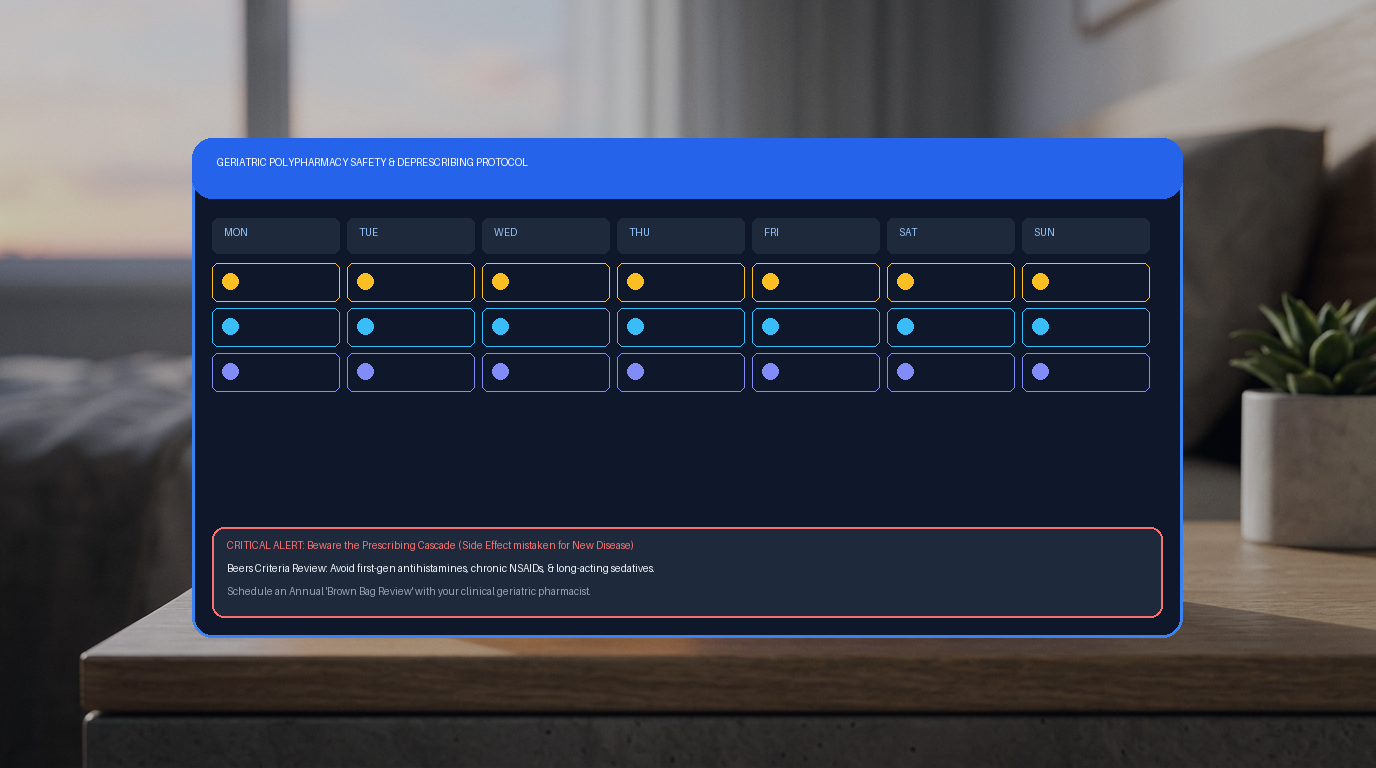
One of the most insidiously dangerous clinical patterns in geriatric medicine is the "Prescribing Cascade". A prescribing cascade occurs when an adverse drug reaction produced by one medication is misinterpreted by a doctor as a brand-new medical illness, prompting the physician to prescribe a second medication to treat the side effect of the first!
Classic examples of prescribing cascades include:
Example 1: An older adult is prescribed amlodipine (a calcium channel blocker) for high blood pressure. Amlodipine causes peripheral fluid leakage and swollen ankles (edema). Instead of recognizing the amlodipine side effect and switching drugs, the doctor diagnoses "congestive heart failure" and prescribes furosemide (a potent water pill). Furosemide causes potassium loss and orthostatic hypotension, causing the patient to feel dizzy and fall, breaking a hip.
Example 2: An older adult with memory loss is prescribed a cholinesterase inhibitor (donepezil). Donepezil increases acetylcholine, triggering bladder hypermotility and urinary incontinence. Instead of identifying the drug cause, the doctor diagnoses "overactive bladder" and prescribes oxybutynin. Oxybutynin is a potent anticholinergic that blocks acetylcholine in the brain, completely worsening the patient's dementia and triggering acute hallucinations!
Breaking the prescribing cascade requires clinicians and caregivers to adopt a universal rule: always rule out a drug side effect before diagnosing a new disease in an older adult.
The Prescribing Cascade Rule
Whenever an older adult develops a new medical symptom—such as fatigue, dizziness, confusion, or ankle swelling—always investigate active medications first before starting a new pill.
4. The Silent Threat: Cumulative Anticholinergic Burden, Delirium, and Falls
Many seemingly harmless prescription and over-the-counter medications possess "anticholinergic" properties—meaning they block the neurotransmitter acetylcholine in the brain and peripheral nervous system. Common culprits include first-generation allergy antihistamines (diphenhydramine / Benadryl), over-the-counter PM sleep aids, bladder-control pills (oxybutynin), tricyclic antidepressants (amitriptyline), and muscle relaxants.
While a single low-dose anticholinergic drug might be tolerated, taking multiple anticholinergic medications creates an alarming cumulative physiological phenomenon known as "Anticholinergic Burden".
In the peripheral body, anticholinergics cause blurred vision, dry mouth, severe constipation, and urinary retention. In the aging brain, acetylcholine is the essential neurotransmitter required for short-term memory, attention, and cognitive processing. High anticholinergic burden induces severe brain fog, memory loss indistinguishable from Alzheimer's disease, acute hospital delirium, and loss of postural reflexes leading to catastrophic falls and fractures. Landmark clinical studies demonstrate that chronic high anticholinergic burden is directly associated with a 50% increased risk of developing permanent dementia.
5. The Beers Criteria: What Every Caregiver Must Know About Inappropriate Drugs
To establish evidence-based guidelines for geriatric safety, the American Geriatrics Society (AGS) maintains and regularly updates the Beers Criteria for Potentially Inappropriate Medication Use in Older Adults.
Originally formulated by geriatrician Dr. Mark Beers, this globally recognized document catalogs dozens of medications whose clinical risks generally outweigh their therapeutic benefits in individuals aged 65 and older.
Key classes highlighted on the Beers Criteria include:
1. Long-Acting Benzodiazepines (diazepam, flurazepam) and "Z-drugs" (zolpidem / Ambien): Associated with motor vehicle collisions, severe cognitive impairment, and hip fractures.
2. Chronic Oral NSAIDs (ibuprofen, naproxen): High risk of gastrointestinal bleeding, acute kidney injury, and worsening heart failure.
3. First-Generation Antihistamines: Extreme sedation, urinary retention, and fall risk.
4. Muscle Relaxants (carisoprodol, cyclobenzaprine): Sedation and fracture risk with questionable long-term efficacy.
6. The Art of Deprescribing: How Geriatricians Systematically Subtract Medications
In medical school, physicians spend thousands of hours learning how to prescribe medications; historically, very little time was spent learning how to stop them. Today, the cutting-edge discipline of "Deprescribing" has revolutionized geriatric healthcare.
Deprescribing is the planned, supervised process of dose reduction or discontinuation of medications that may be causing harm, are no longer providing therapeutic benefit, or no longer align with the patient's current health goals.
A comprehensive deprescribing audit follows a structured clinical methodology: first, compiling an exhaustive list of every pill, drop, and supplement; second, identifying the explicit medical indication for each; third, evaluating the risk-benefit ratio against current life expectancy and organ function; and fourth, prioritizing medications for gradual, stepped tapering with close clinical monitoring. Deprescribing is not about denying treatment—it is about restoring vitality and independence.
“Anyone can prescribe a pill. It takes an expert, compassionate clinician to carefully deprescribe an unnecessary medication and give an older adult their clarity back.”
— American Geriatrics Society Deprescribing Consortium
7. The Master Geriatric High-Risk Medications and Safer Alternatives Table
The following reference table summarizes high-risk medications commonly identified on the Beers Criteria and safer clinical alternatives for older adults:
| High-Risk Medication Class | Common Brand Examples | Major Clinical Peril in Elderly | Safer Evidence-Based Alternative |
|---|---|---|---|
| First-Gen Antihistamines | Diphenhydramine (Benadryl), Chlorpheniramine | High anticholinergic burden, confusion, falls, urinary retention | Second-gen non-sedating agents (cetirizine, fexofenadine) |
| Benzodiazepines & Z-Drugs | Diazepam (Valium), Zolpidem (Ambien) | Prolonged half-life, daytime sedation, severe hip fractures | Non-pharmacological sleep hygiene, CBT-I, melatonin |
| Chronic Oral NSAIDs | Ibuprofen, Naproxen, Diclofenac oral | Peptic ulcer hemorrhage, acute renal failure, fluid retention | Topical diclofenac gel, acetaminophen (monitored dose) |
| Tricyclic Antidepressants | Amitriptyline, Doxepin, Imipramine | Severe orthostatic hypotension, cardiac arrhythmias, dry mouth | SSRIs (sertraline, escitalopram) at conservative starting doses |
| Sliding-Scale Regular Insulin | Regular insulin sliding scales without basal | High risk of severe hypoglycemic coma and death | Standard basal insulin regimens with consistent carbohydrate dosing |
| Long-Acting Sulfonylureas | Glyburide (Micronase) | Prolonged, severe hypoglycemia due to active metabolites | Glipizide, SGLT2 inhibitors, or DPP-4 inhibitors |
8. Actionable Caregiver Protocol: How to Conduct a Annual "Brown Bag" Medication Review
If you care for an aging parent or loved one taking multiple daily medications, you can take immediate action to protect them by organizing an annual "Brown Bag Medication Review":
Step 1: Gather every single medication. Go through every medicine cabinet, bedside table, and kitchen shelf. Place every prescription bottle, inhaler, eye drop, vitamin, herbal supplement, and over-the-counter pain reliever into a large brown grocery bag.
Step 2: Schedule a dedicated medication review appointment with their primary care physician or geriatric clinical pharmacist. Make sure the visit is booked specifically for reviewing medications, rather than squeezing it into an acute illness consultation.
Step 3: Empty the bag on the clinic table. Review every item together and ask four powerful clinical questions: "1. What is the active indication for this specific pill? 2. Is this medication still necessary at their current age? 3. Could any of their current symptoms (fatigue, dizziness, memory slips) be a side effect of this drug? 4. Can we safely taper or eliminate this prescription?"
Step 4: Digitize and organize the schedule. Use digital platforms like Theprescription to maintain an accurate, cloud-accessible record of your loved one's active prescriptions, cross-check potential drug-drug interactions, and monitor timing schedules with complete clarity.
Key Clinical Takeaways for Patients
- Polypharmacy is clinically defined as the concurrent use of five or more prescription medications, affecting over 40% of adults aged 65 and older.
- Aging alters pharmacokinetics: reduced renal clearance, diminished hepatic blood flow, increased body fat percentage, and reduced total body water amplify drug toxicity.
- The "Prescribing Cascade" occurs when a medication side effect is misdiagnosed as a new medical illness, prompting the prescription of yet another unnecessary drug.
- Cumulative "Anticholinergic Burden" from common allergy, sleep, bladder, and psychiatric pills causes severe confusion, memory loss, urinary retention, and fatal falls.
- The Beers Criteria and STOPP/START guidelines provide evidence-based roadmaps for clinicians and caregivers to safely deprescribe inappropriate medications.
Medical Disclaimer: Medical Disclaimer: This article is published solely for educational, health literacy, and informational purposes. Theprescription is not a certified medical device and does not dispense medical advice. Patients must never alter, stop, or initiate prescription medications without direct clinical consultation with a licensed physician and dispensing pharmacist. Originally published on Theprescription.