Pediatric Dosing and Liquid Medications: Preventing Accidental Overdoses in Infants and Children
Why Kitchen Spoons Cause Fatal Pediatric Overdoses: The Science of Oral Syringes, Milligram-per-Kilogram Weight Calculations, and Liquid Paracetamol Safety
Why Kitchen Spoons Cause Fatal Pediatric Overdoses: The Science of Oral Syringes, Milligram-per-Kilogram Weight Calculations, and Liquid Paracetamol Safety
1. The Vulnerable Physiology of Childhood: Why Kids Require Precision
It is 2:30 in the morning. Your two-year-old child wakes up crying inconsolably, burning with a 103°F (39.4°C) fever. Exhausted, frantic, and operating in a dimly lit nursery, you grab a bottle of liquid fever reducer from the cabinet, reach into the kitchen silverware drawer for a teaspoon, pour the red syrup to the brim, and feed it to the child.
This scene plays out in millions of homes every single week. Yet pediatric clinical emergency departments treat over 70,000 children every year for accidental medication overdoses—the vast majority occurring not from malicious neglect, but from loving parents making simple liquid measurement mistakes in stressful nighttime situations.
Children are not simply miniature adults. An infant or young child possesses immature hepatic metabolic enzymes, evolving glomerular kidney filtration, lower plasma protein binding, and a much higher percentage of body water. A dosing error of just 2 or 3 milliliters that an adult body would shrug off can overwhelm a toddler's liver or kidneys, triggering acute hepatic failure or respiratory depression. Pediatric medication demands uncompromising precision.
2. The Kitchen Spoon Hazard: Why Household Cutlery Causes Pediatric Tragedies
For generations, liquid medicine instructions used colloquial culinary terms: "take one teaspoonful" or "take half a tablespoonful". This historical terminology has proven to be a public health disaster.
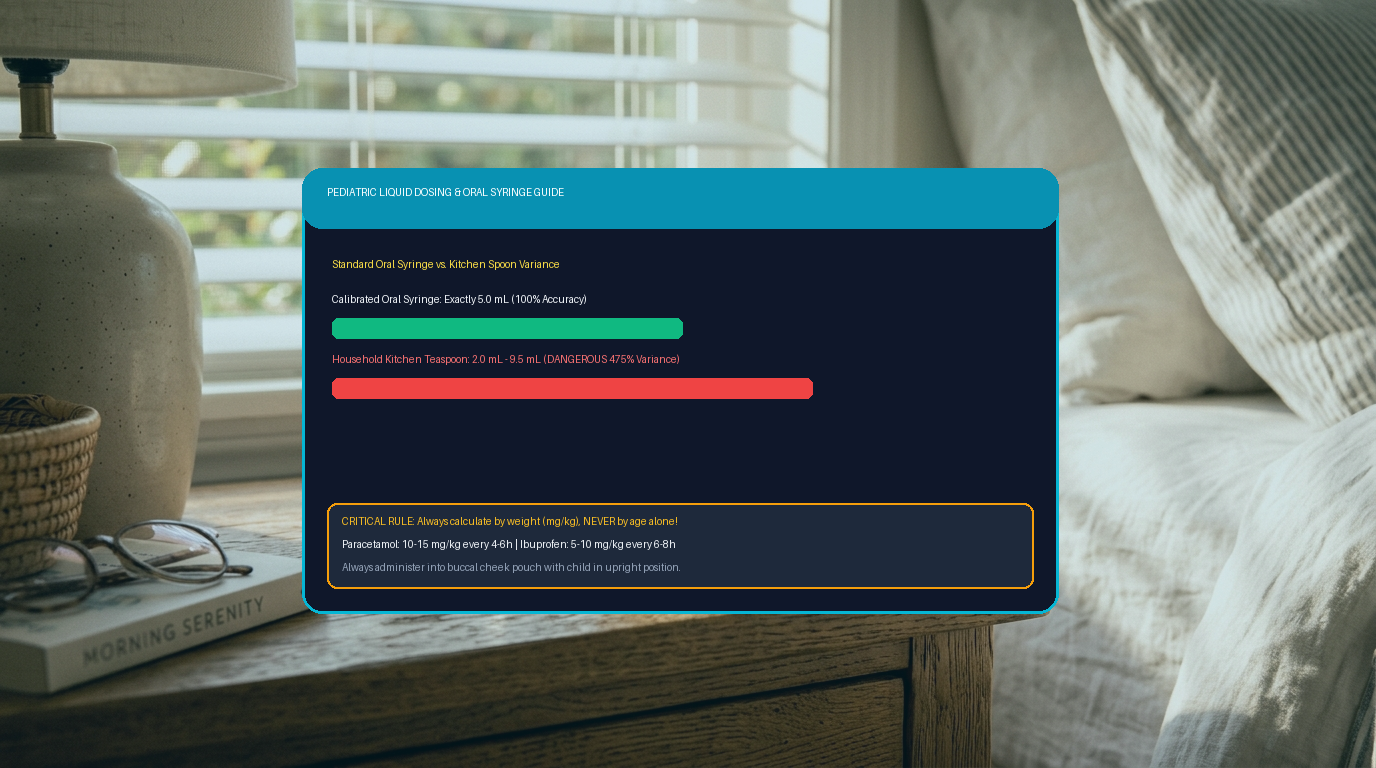
Extensive laboratory investigations by the American Academy of Pediatrics (AAP) and poison control centers have evaluated hundreds of household tableware spoons collected from real family kitchens. The findings were staggering: kitchen "teaspoons" varied wildly in actual fluid capacity from as little as 2.0 milliliters to as much as 9.5 milliliters—a nearly 500% variance! Similarly, household tablespoons ranged from 8 mL to over 22 mL.
When a parent uses a deep soup spoon or heavy decorative silverware to dispense an antibiotic or fever reducer, they may be delivering triple the intended dose, precipitating toxicity. Conversely, using a shallow silver teaspoon underdoses the child, causing antibiotic failure and prolonged sepsis. Major medical societies now strictly mandate that liquid medications must NEVER be measured with kitchen silverware.
Banish Kitchen Spoons from Medicine
Never use household kitchen spoons or cutlery to measure medicine. Kitchen spoons vary from 2 mL to 10 mL and cause life-threatening accidental overdoses. Always use a calibrated oral syringe.
3. The Science of Weight-Based Dosing: Why Weight Trumps Age Every Time
When you read over-the-counter medicine packages at the pharmacy, the packaging frequently features age-based charts: "Ages 2 to 3: 5 mL; Ages 4 to 5: 7.5 mL." Pediatricians strongly caution against relying solely on age.
Children of the exact same age exhibit dramatic variations in physical size and mass. A healthy 3-year-old may weigh 11 kilograms (24 pounds), while another healthy 3-year-old may weigh 18 kilograms (40 pounds)—a 60% mass difference! Dosing both children with the identical 5 mL syrup volume means the smaller child is significantly overdosed, while the larger child receives an ineffective sub-therapeutic dose.
In clinical pharmacology, pediatric dosing is calculated strictly by body weight: milligrams of drug per kilogram of body weight (mg/kg/dose). For example, the standard pediatric dose for acetaminophen (paracetamol) is 10 to 15 mg/kg per dose every 4 to 6 hours (maximum 75 mg/kg/day). For liquid ibuprofen, the standard pediatric dose is 5 to 10 mg/kg per dose every 6 to 8 hours (maximum 40 mg/kg/day). Always know your child's current weight in kilograms before administering liquid medications.
4. Concentration Confusion: The Peril of Infant Drops vs. Children's Elixirs
One of the most dangerous traps in pediatric medicine involves concentration discrepancies within the same brand name.
Historically, infant acetaminophen drops were manufactured in an ultra-concentrated formula (80 mg per 0.8 mL), while children's liquid syrup was much more dilute (160 mg per 5 mL). Why? Because young infants cannot swallow large volumes of fluid, requiring a tiny, potent drop.
However, this disparity resulted in catastrophic poisonings: well-meaning parents who ran out of infant drops bought children's liquid, assumed a dropperful was the same, or vice versa, accidentally administering triple or quadruple doses of concentrated infant medicine to older siblings. Although regulatory agencies standardized liquid acetaminophen to a single universal strength (160 mg per 5 mL) in many countries, other liquid medications (including infant ibuprofen, gas drops, and vitamins) still exist in conflicting concentrations. Always check the milligrams per milliliter (mg/mL) printed on the bottle label!
5. Paracetamol and Ibuprofen: The Dangers of Fever "Stacking" and Overdose
When a child develops a stubborn high fever that fails to break after a single dose of acetaminophen, anxious parents frequently turn to alternating or "stacking" regimens—giving acetaminophen, then ibuprofen three hours later, then acetaminophen again.
While alternating these two different antipyretic classes is sometimes recommended by pediatricians for refractory fevers, it carries severe safety hazards. Sleep-deprived parents easily lose track of which medicine was given at what time, accidentally repeating the same drug twice within a short window.
Furthermore, multi-symptom over-the-counter pediatric cough, cold, and flu syrups often contain hidden acetaminophen in addition to decongestants. If a parent gives a child a dose of cold syrup and simultaneously administers a dose of liquid paracetamol for fever, the child receives a double dose of acetaminophen. Acetaminophen overdose is the number one cause of acute liver failure in pediatric populations worldwide.
Hidden Acetaminophen in Cold Syrups
Never combine pediatric cough/cold syrups with acetaminophen fever medicine without checking ingredients. Many cold syrups already contain paracetamol, and combining them causes acute toxic liver failure.
6. The Oral Syringe: How to Measure and Administer Liquids Accurately
The undisputed gold standard tool for administering liquid medicine to infants and young children is a plastic calibrated oral syringe.
How to measure accurately: Invert the bottle (or insert the bottle adapter), pull the syringe plunger back slowly until the leading edge of the black rubber ring aligns exactly with the desired milliliter (mL) mark. Check the syringe at eye level under bright light, ensuring there are no large air bubbles trapped in the barrel.
How to administer safely: Place the child in an upright or slightly reclined seated position—NEVER lying flat on their back, which provokes choking and pulmonary aspiration. Place the syringe tip gently inside the child's mouth between the gums and the inside of the cheek (the buccal pouch). Slowly push the plunger in small increments, allowing the child to swallow naturally. Never shoot the liquid directly into the back of the throat, as this can trigger a violent laryngeal gag reflex or enter the trachea.
7. The Master Pediatric Liquid Medication Measurement Reference Guide
The following reference table outlines standard pediatric liquid measurement conventions, dosing tools, and critical safety rules for parents:
| Liquid Dosing Device | Measurement Accuracy | Safety Rating | Clinical Recommendation |
|---|---|---|---|
| Calibrated Oral Syringe | Highest precision (+/- 0.1 mL) | GOLD STANDARD (Safest) | Always use for infants & toddlers; dispense into cheek pouch |
| Dosing Cup with mL Marks | Moderate precision (+/- 0.5 mL) | Acceptable for older kids | Only for older children who can drink independently; view at eye level |
| Cylindrical Dosing Spoon | Moderate precision | Acceptable for liquid antibiotics | Ensure child drinks entire volume including thick residual syrup |
| Household Kitchen Teaspoon | UNACCEPTABLE (2 mL to 9.5 mL variance) | DANGEROUS / PROHIBITED | Never use cutlery; causes severe overdoses or sepsis underdosing |
| Household Tablespoon | UNACCEPTABLE (8 mL to 22 mL variance) | EXTREME HAZARD | Never use for pediatric medicine administration |
8. The Caregiver Action Plan: Preventing Pediatric Accidental Ingestions
Protect your children and infants by embedding these five essential pediatric safety protocols into your home routine:
Rule 1: Always use milliliters (mL). Never speak in teaspoons, drops, or mouthfuls. Insist that your pediatrician and pharmacist write and communicate all liquid orders strictly in milliliters.
Rule 2: Maintain a written "Dosing Log". Stick a magnetic whiteboard or notepad on the refrigerator. Every time a dose is given, record: Drug Name, Exact mL Given, Time, and Caregiver Initials. This prevents one parent from giving a dose at 8:00 PM and the other parent accidentally giving another dose at 8:30 PM.
Rule 3: Never call medicine "candy". Pediatricians strongly caution against telling a child that sweet medicine is candy to get them to drink it. Children who believe syrup is candy will actively search for the bottle when unsupervised and drink the entire contents.
Rule 4: Store high and out of reach in child-resistant cabinets. Child-resistant caps are child-resistant, NOT child-proof; determined toddlers can pry them open.
Rule 5: Use digital prescription assistants. With Theprescription, you can scan pediatric prescription slips to verify weight-based dosing ranges, check liquid concentrations, and ensure your child receives exactly what the doctor ordered.
In routine clinical practice, active patient engagement represents the single greatest safeguard against preventable medication errors. When individuals take time to review their prescription orders, verify the correct indications, and clarify all ambiguous instructions prior to leaving the medical clinic, treatment adherence improves dramatically while adverse drug reactions decline.
Key Clinical Takeaways for Patients
- Children are not miniature adults; pediatric pharmacology requires strict milligram-per-kilogram (mg/kg) weight-based dosing rather than age-based approximations.
- Household kitchen spoons vary in volume from 2 mL to 10 mL, causing severe underdosing or life-threatening 300% overdoses; only calibrated oral syringes should be used.
- Liquid pediatric acetaminophen (paracetamol) and ibuprofen have different concentrations (infant drops vs. children's syrup) that must never be confused.
- Never refer to medicine as "candy" or "sweet treats" to persuade a child to swallow liquid syrups; this is a leading cause of exploratory pediatric poisonings.
- Always measure liquid medication doses in milliliters (mL) using marked syringes with adequate lighting, and keep a written log of administration times.
Medical Disclaimer: Medical Disclaimer: This article is published solely for educational, health literacy, and informational purposes. Theprescription is not a certified medical device and does not dispense medical advice. Patients must never alter, stop, or initiate prescription medications without direct clinical consultation with a licensed physician and dispensing pharmacist. Originally published on Theprescription.