The Mystery of Doctor Handwriting: Why Physicians Write in Cursive and How Pharmacists Decode It
An In-Depth Investigation into Medical Penmanship, High Cognitive Workloads, Cursive Ligatures, and the Clinical Safeguards That Prevent Prescription Errors
An In-Depth Investigation into Medical Penmanship, High Cognitive Workloads, Cursive Ligatures, and the Clinical Safeguards That Prevent Prescription Errors
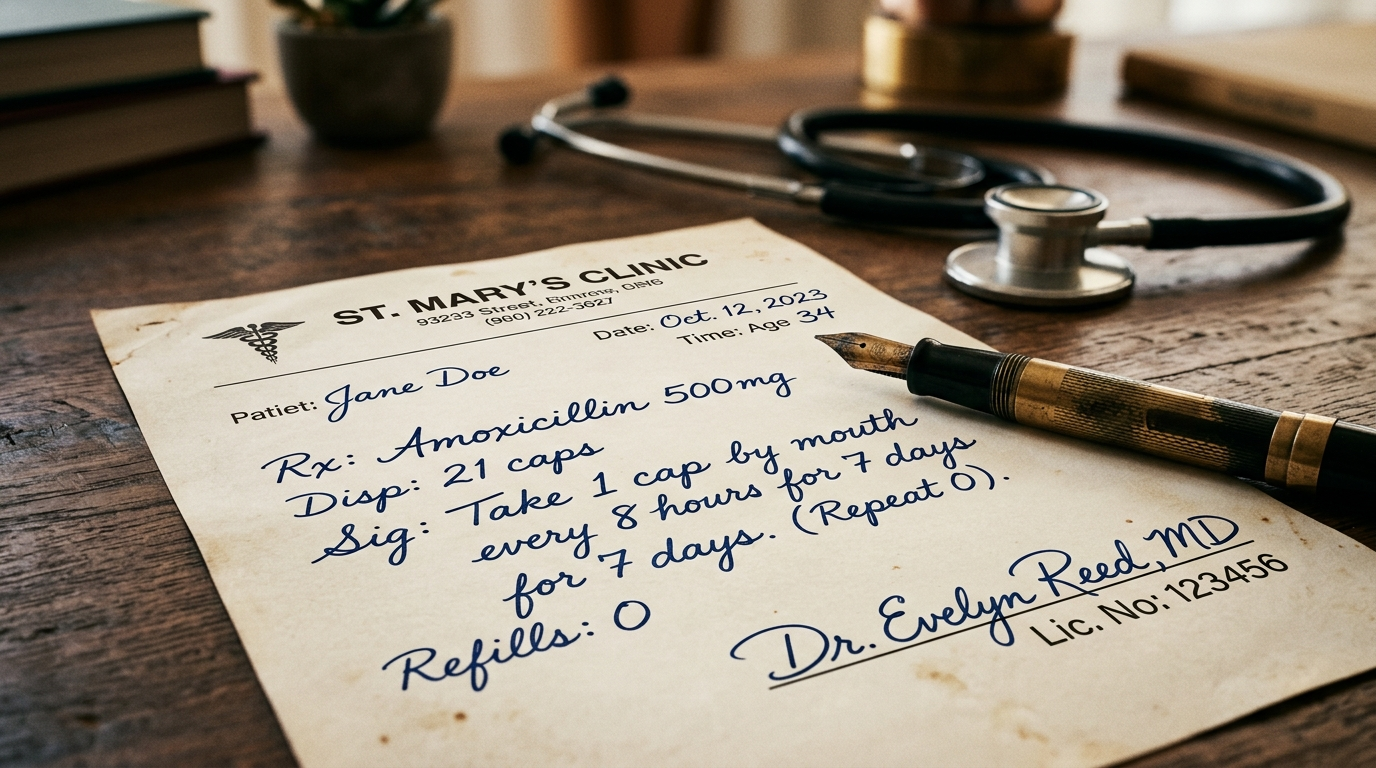
1. The Universal Trope: Why Is Doctor Handwriting So Notoriously Bad?
Few cultural tropes are as universally recognized across the globe as the physician's indecipherable handwriting. From bustling outpatient departments in New Delhi and London to busy emergency rooms in New York and Tokyo, patients routinely walk out of clinical consultations holding a slip of paper covered in what appears to be abstract line art, squiggles, or wavy undulating cardiogram lines rather than recognizable Latin letters.
Historically, the stereotype suggested that physicians were either indifferent to penmanship or intentionally writing in esoteric shorthand to protect medical knowledge behind an exclusionary guild barrier. Modern clinical research, however, reveals a starkly different truth.
During an average 12-hour hospital shift, a physician may write, sign, or annotate between forty and seventy individual patient records, prescription slips, discharge summaries, laboratory requisition forms, and diagnostic order sets. When physical writing speed must desperately keep pace with rapid diagnostic reasoning and sudden emergency arrivals, the fine motor mechanics responsible for crisp letter formation inevitably break down, giving rise to the characteristic compressed cursive script known throughout the healthcare ecosystem.
“The illegibility of prescriptions is rarely an aesthetic choice; it is the physical symptom of an overburdened healthcare delivery system where diagnostic speed and patient throughput constantly collide with manual analog documentation.”
— Journal of Medical Ethics and Clinical Informatics
2. Clinical Biomechanics: Muscle Fatigue, High Patient Volumes, and Cognitive Overload
To comprehend why medical handwriting degenerates so rapidly, one must examine the physiological biomechanics of the human hand combined with acute cognitive saturation. Writing is a high-order motor skill coordinated by the small intrinsic muscles of the hand — the thenar and hypothenar eminences, the lumbricals, and the interossei muscles — working in micro-second synchrony with the flexor digitorum superficialis and profundus tendons of the forearm.
In high-volume public hospitals and community clinics, outpatient doctors frequently consult sixty to ninety patients in a single morning session. If each patient consultation requires documenting symptoms, blood pressure vitals, differential diagnoses, generic salt formulas, and lifestyle advice, the doctor's hand experiences continuous repetitive strain.
Compounding this physical exhaustion is severe cognitive load. A medical practitioner is simultaneously calculating renal dosage adjustments based on serum creatinine clearance, screening for dangerous drug-drug interactions, checking patient allergy histories, and answering urgent nursing inquiries.
Clinical Insight: The Micro-Economy of Consultations
In outpatient clinics with an average consultation time of 7 to 10 minutes per patient, a physician spends up to 4 minutes on manual documentation. Minimizing pen lifts by writing in fluid cursive saves an estimated 20 to 30 seconds per prescription — compounding to nearly an hour saved over a demanding 80-patient clinic shift.
3. The Anatomy of Medical Cursive: Ligatures, Terminal Strokes, and Shorthand Loops
While physician handwriting appears entirely chaotic to the untrained patient eye, forensic document examiners and seasoned pharmacists know that it adheres to consistent structural patterns. Medical cursive is characterized by elongated ligatures — the connecting strokes that bridge one letter to the next.
Furthermore, physicians routinely use rapid terminal dismissals. In writing long pharmaceutical brand names or multi-syllabic generic molecules (such as "Amoxicillin" or "Hydrochlorothiazide"), the doctor frequently forms the first two or three letters with reasonable clarity ("Amox..." or "HCTZ...") before trailing off into a stylized horizontal wavy tail.
Another distinctive element is the heavy reliance on historical Latin shorthand. Rather than spelling out English sentences, doctors use compressed Latin sigils: "Tab Augmentin 625 mg 1 tab PO BD PC x 5/7".
4. The Pharmacist Decryption Protocol: How Dispensers Read What Patients Cannot
When a patient hands an incomprehensible prescription slip across the pharmacy counter, how does the dispensing pharmacist decipher the text without making catastrophic errors? The public often assumes pharmacists possess supernatural decoding skills.
First, the pharmacist examines the prescription header to identify the prescribing physician's specialty or clinic type. A prescription issued by a pediatric pulmonologist is vastly more likely to contain bronchodilators, nebulizer solutions, and oral steroids than statins or antihypertensives.
Second, pharmacists examine the numerical values: dosage strengths and frequency codes. Even if the drug name is reduced to an ambiguous cursive wave, a dosage of "20 mg" taken "OD at bedtime" paired with a cardiologist's stamp dramatically narrows the possibilities to atorvastatin, rosuvastatin, or telmisartan.
Most importantly, when ambiguity persists, licensed pharmacists operate under an uncompromising ethical and legal mandate: never guess. Pharmacists routinely hold dispensing, contact the clinic via dedicated telephone lines, or send secure digital inquiries to verify the intended medication directly with the prescriber before any pill leaves the dispensing dispensary.
| Clinical Anchor | Diagnostic Context | Handwriting Clue Decoded | Probable Medication |
|---|---|---|---|
| Cardiology Outpatient | Hypertension & Dyslipidemia | Wavy stroke starting with "Ator..." at "20 mg OD" | Atorvastatin 20 mg Tab |
| Gastroenterology Clinic | Acid Reflux / Peptic Ulcer | Loop with "Pan..." before food "OD AC" | Pantoprazole 40 mg Gastro-resistant |
| Pulmonology & Chest | Acute Bronchitis / Cough | Short scribble with "Aug..." 625 mg "1-0-1" | Amoxicillin + Clavulanate (Augmentin) |
| Orthopedic Surgery | Acute Joint Sprain / Pain | Undulating script "Aceclo..." 100 mg "BD PC" | Aceclofenac 100 mg Tablet |
5. When Bad Handwriting Turns Dangerous: Historical Case Studies and LASA Hazards
Although illegible handwriting is often treated with good-humored tolerance, the clinical consequences of misinterpretation can be severe. Medical literature has documented tragic instances where cursive ambiguity resulted in medication errors, adverse drug events, and prolonged hospital stays.
The primary threat arises from Look-Alike, Sound-Alike (LASA) pharmaceutical pairs. For instance, the antidepressant Celexa (citalopram) and the arthritis painkiller Celebrex (celecoxib) possess remarkably similar brand letter sequences.
Another perennial danger lies in decimal point placement and metric abbreviations. A physician intending to prescribe "0.5 mg" of digoxin who fails to place a prominent leading zero (" .5 mg") creates a high-risk scenario where the faint decimal point is missed, leading the pharmacy to dispense "5 mg" — a ten-fold overdose of a narrow therapeutic index cardiac medication that can induce fatal arrhythmias.
Safety Warning: The Leading Zero Mandate
Never omit leading zeros! Modern prescription safety protocols strictly prohibit writing ".5 mg" due to the risk of 10-fold overdosing. It must always be written as "0.5 mg". Conversely, trailing zeros must be avoided: write "5 mg", never "5.0 mg", to prevent mistaking it for "50 mg".
6. Global Regulatory Interventions: From Legibility Laws to Mandatory E-Prescribing
Recognizing that manual handwriting is inherently susceptible to human fatigue and visual misinterpretation, healthcare statutory bodies around the world have enacted strict legal frameworks and technological mandates to eliminate illegible paper orders.
In India, the Medical Council of India (MCI) and the National Medical Commission (NMC) issued statutory guidelines mandating that all registered medical practitioners must write prescriptions legibly, preferably in capital block letters, and explicitly include the generic chemical salt name alongside any brand designation. Several state high courts have reinforced this mandate by issuing directives penalizing illegible handwriting that compromises patient safety.
In the United States and the European Union, the transition has focused heavily on Electronic Health Records (EHR) and Computerized Physician Order Entry (CPOE) systems. Mandates such as the HITECH Act and Medicare e-prescribing standards have shifted over 90% of ambulatory care prescriptions from paper pads to encrypted cloud transmissions directly routed to pharmacy terminals.
7. The Patient Protection Protocol: 5 Steps to Take Before Leaving Your Doctor's Office
Patients must never feel intimidated or hesitant when asking their doctor or clinical staff to clarify a handwritten prescription. Active patient participation is recognized by patient advocacy organizations as the single most effective barrier against medication errors.
First, ask the physician to read the prescription aloud before leaving the consultation room: "Doctor, could you please review the medicine names and timings with me once?" As the doctor speaks, jot down the spoken drug names and timings in your mobile phone notes or verify that you can clearly read every line.
Second, verify the generic salt and primary indication: "What does this specific tablet treat, and what is its active generic molecule?" Knowing that a tablet is for stomach acid versus blood pressure provides an instant safety net if the pharmacy hands you an unexpected pill.
Third, clarify timing relative to food: does "BD" mean before breakfast and before dinner, or does it require food in the stomach to prevent gastric irritation? Fourth, ask if the doctor can write key names in capital block letters if the cursive appears faint or heavily ligated.
8. The Next Frontier: How Computer Vision and Ensemble AI Demystify Handwriting
Despite widespread digital adoption, millions of clinical interactions across community clinics, urgent care centers, and home doctor visits still rely on paper prescription slips. To bridge this persistent analog gap, advanced artificial intelligence, multimodal large language models, and deep neural stroke reconstruction algorithms are pioneering a new standard of accessible healthcare literacy.
State-of-the-art medical OCR does not rely on rudimentary optical pixel matching. Modern AI engines process prescription images through multi-stage neural pipelines: first performing geometric document deskewing and contrast normalization, followed by cursive ligature stroke tracing that resolves overlapping loops.
By empowering patients to take a clear photograph of their paper prescription and receive an instant, plain-English breakdown of certified generic salts, meal-timing rules, and interactive taking schedules, platforms like Theprescription are democratizing clinical literacy. While AI serves as a powerful educational decision-support tool and never replaces the clinical judgment of licensed healthcare providers, it represents an unprecedented leap forward in making handwritten medical advice clear, transparent, and safe for every household.
Key Clinical Takeaways for Patients
- Physicians do not deliberately write poorly; acute cognitive load, severe time pressure, muscle fatigue from writing 40-60 notes daily, and high documentation burdens naturally erode fine motor coordination.
- Doctor handwriting follows identifiable cursive ligatures, loops, and rapid terminal stroke dismissals that trained pharmacists systematically decipher using clinical context.
- Pharmacists never guess: they employ a rigorous multi-tier triage including diagnosis matching, patient age, dosing plausibility, and direct telephone verification when scripts are unclear.
- Patients have an inviolable statutory right to have prescriptions legibly explained and should never leave a clinic without knowing their exact drug names, salts, and daily timings.
- Modern artificial intelligence and optical stroke reconstruction models are revolutionizing healthcare by transforming messy physician penmanship into clean, structured digital schedules.
Medical Disclaimer: Medical Disclaimer: This article is published solely for educational, health literacy, and informational purposes. Theprescription is not a certified medical device and does not dispense medical advice. Patients must never alter, stop, or initiate prescription medications without direct clinical consultation with a licensed physician and dispensing pharmacist. Originally published on Theprescription.