Deciphering Doctor Shorthand: The Ultimate Guide to Prescription Latin Codes (OD, BD, TDS, AC, PC, SOS)
Demystifying Centuries-Old Medical Abbreviations on Your Prescription Slips, Why Pharmacists Memorize Latin Syntax, and How to Prevent Medication Timing Errors
Demystifying Centuries-Old Medical Abbreviations on Your Prescription Slips, Why Pharmacists Memorize Latin Syntax, and How to Prevent Medication Timing Errors
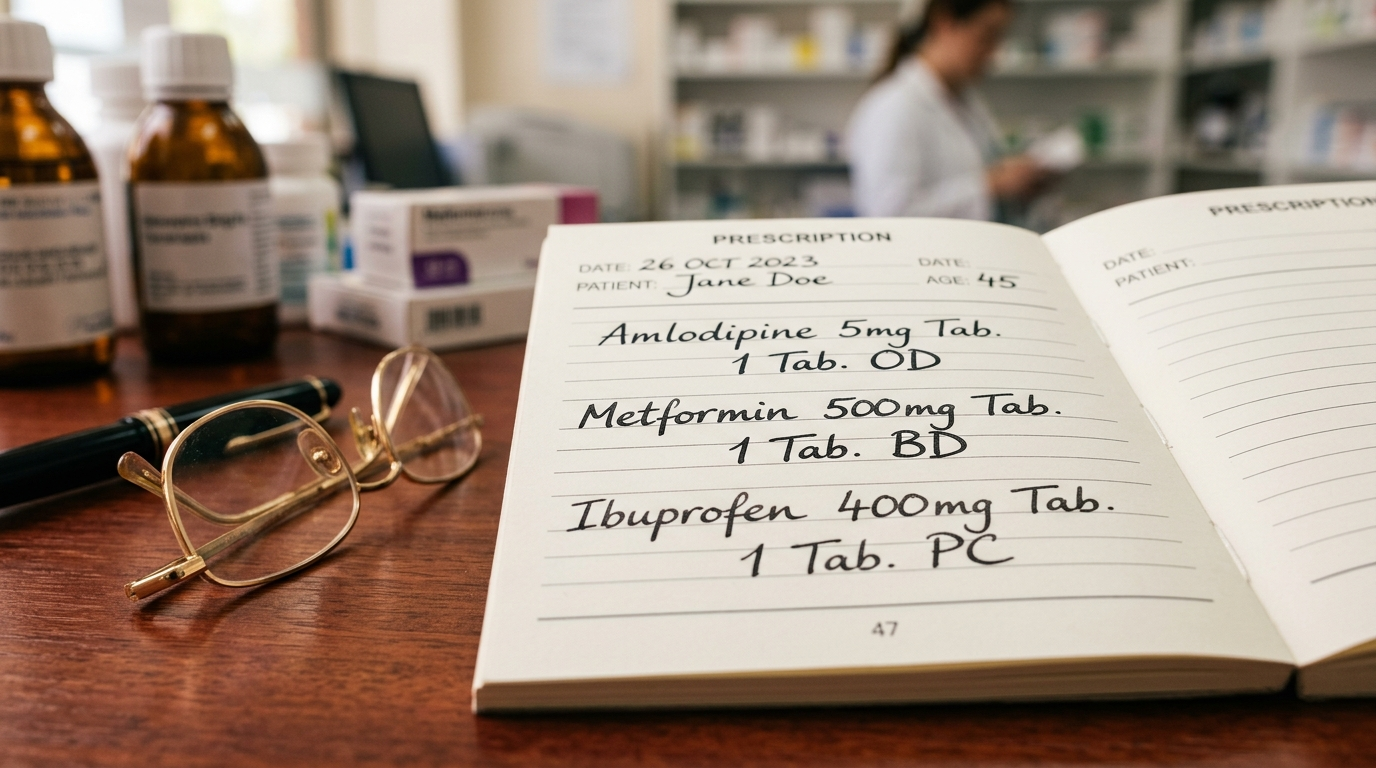
1. The Secret Code on Your Slip: Why Medicine Still Uses Latin
When you receive a paper prescription slip from a physician or surgeon, the document often resembles an arcane cipher. Alongside drug names like amoxicillin or metoprolol, the doctor scrawls cryptic letter clusters such as "1 tab BD PC x 5/7" or "Cap 1 TDS AC" or "Tab SOS".
Why does modern twenty-first-century medicine still rely on abbreviated Latin terminology? The historical roots trace back over two millennia.
Over subsequent centuries, this formal Latin medical syntax was condensed into rapid clinical shorthand to save precious physician time during demanding clinical rounds. In modern medical practice, while digital Electronic Health Records (EHR) increasingly format instructions into plain vernacular language, millions of outpatient prescriptions and hospital medication administration records (MAR) continue to utilize these enduring Latin abbreviations every single day.
2. Frequency Abbreviations: Mastering OD, BD, TDS, and QDS
The most critical category of prescription shorthand is frequency notation. These codes dictate how many times per day a medication must enter your bloodstream, which directly establishes the pharmacokinetic steady-state concentration necessary to suppress disease pathology without causing cumulative systemic toxicity.
OD stands for "Omni Die", Latin for "every day" or "once daily". When a physician prescribes an OD medication, such as an antihypertensive or a cholesterol-lowering statin, it signifies that the pill should be taken once within each 24-hour cycle, preferably at the identical hour each day to avoid peaks and valleys in drug serum levels.
BD (or BID) stands for "Bis in Die", meaning "twice a day". In clinical pharmacology, a BD directive typically requires dosing every 12 hours (for instance, 8:00 AM and 8:00 PM), rather than taking two pills within a compressed four-hour evening window.
TDS (or TID) stands for "Ter Die Sumendum" or "Ter in Die", meaning "three times a day". This schedule usually aligns with an 8-hour dosing interval (e.g., 7:00 AM, 3:00 PM, and 11:00 PM) or with primary daily meals when gastrointestinal tolerability is paramount.
QDS (or QID) stands for "Quater Die Sumendum" or "Quater in Die", signifying "four times a day". This intensive 6-hour cadence is common for rapidly cleared short-acting antibiotics (such as cephalexin or cloxacillin) and liquid oral suspensions where continuous bacterial inhibition is mandatory.
Pharmacokinetic Spacing Rule
Frequency abbreviations are not merely arbitrary suggestions. BD means every 12 hours; TDS means every 8 hours; QDS means every 6 hours. Maintaining consistent hourly intervals keeps the active drug concentration above the minimum effective therapeutic threshold.
3. Meal-Timing Abbreviations: Understanding AC, PC, and OM/ON
A pill's bioavailability and gastrointestinal safety are profoundly influenced by whether food is present in the stomach. Physicians use specific shorthand codes to instruct patients whether to swallow their medicine before, during, or after eating.
AC stands for "Ante Cibum", which translates directly from Latin as "before food" or "before meals". When an AC code appears, the medication should generally be swallowed with water approximately 30 to 60 minutes prior to a meal.
PC stands for "Post Cibum", translating to "after food" or "after meals". A PC medication should be taken within 15 to 30 minutes following a substantial meal or snack.
Other vital timing codes include OM ("Omni Mane" - every morning), ON ("Omni Nocte" - every night), and HS ("Hora Somni" - at the hour of sleep / bedtime). Sedating antihistamines and sleep aids are routinely marked ON or HS, while activating stimulants and water pills (diuretics) are marked OM to prevent nocturnal urination.
4. As-Needed and Emergency Codes: Deciphering SOS, PRN, and Stat
Not all medical therapies follow rigid, around-the-clock schedules. Many medications are prescribed conditionally, to be taken only when specific clinical symptoms arise.
PRN stands for "Pro Re Nata", an elegant Latin phrase meaning "as the circumstance arises" or "as needed". A prescription reading "Paracetamol 500mg 1 tab PO Q6H PRN headache" tells the patient: swallow one tablet by mouth every 6 hours if you have a headache, but do not take the medication if you feel fine.
SOS stands for "Si Opus Sit", meaning "if there is need" or "in case of emergency". While closely related to PRN, in many clinical traditions (especially across Commonwealth and South Asian medical practice), SOS denotes a rescue medication intended for acute distress—such as sublingual nitroglycerin for sudden angina chest pain, an inhaler for acute bronchial wheezing, or an oral anti-emetic for sudden vomiting.
Stat stands for "Statim", meaning "immediately" or "without delay". A stat order in a hospital or urgent care clinic signifies an emergency single dose that must be administered right away to stabilize an acute life-threatening condition.
Safety Rule on PRN / SOS Prescriptions
Every PRN and SOS medication must have a clearly stated maximum daily dose and minimum hourly interval. Never exceed the daily ceiling (e.g., maximum 4,000 mg of paracetamol in 24 hours), even if symptoms persist.
5. Route of Administration Codes: PO, SL, PR, and Inhalations
A prescription must explicitly define how the pharmaceutical formulation enters the patient's body. Mistaking the route of administration can lead to severe adverse events or complete therapeutic failure.
PO stands for "Per Os", Latin for "by mouth". This is the most common route, indicating that tablets, capsules, or oral liquids should be swallowed into the digestive tract.
SL stands for "Sub Lingual", meaning "under the tongue". Sublingual medications (such as nitroglycerin for chest pain or certain anti-nausea wafers) dissolve directly across the rich capillary bed beneath the tongue, bypassing liver first-pass metabolism for ultra-rapid therapeutic onset.
PR stands for "Per Rectum", indicating rectal suppositories or enemas, utilized when a patient is actively vomiting, unconscious, or experiencing severe gastrointestinal obstruction.
Top stands for "Topical", denoting creams, ointments, or transdermal patches applied directly to intact skin.
Ophthalmic and Otic codes require rigorous precision: OD ("Oculus Dexter" - right eye), OS ("Oculus Sinister" - left eye), and OU ("Oculus Uterque" - both eyes). In contrast, AD ("Auris Dextra" - right ear), AS ("Auris Sinistra" - left ear), and AU ("Auris Utraque" - both ears) designate ear drops.
6. The Dangerous Abbreviations: Why Modern Hospitals Ban QD, U, and MSO4
While Latin abbreviations streamline physician notes, their hasty handwritten execution has historically caused catastrophic medical errors. In response, leading patient safety organizations—including the Institute for Safe Medication Practices (ISMP) and The Joint Commission—have created mandatory "Do Not Use" abbreviation lists across accredited hospitals worldwide.
The most dangerous banned abbreviations include:
1. "QD" (intended for every day) versus "QOD" (every other day): In hurried cursive, an unclosed "O" makes QOD look identical to QD, resulting in patients receiving double the intended chemotherapy or blood-thinning dose.
2. "U" (intended for units): When scribbled quickly, the letter "U" is easily mistaken for a zero ("0") or the number "4".
3. Trailing Zeros and Naked Decimals: Writing "5.0 mg" instead of "5 mg" can lead to the decimal point being overlooked, dispensing 50 mg (a 10-fold overdose).
4. "MSO4" and "MgSO4": MSO4 represents morphine sulfate (a potent narcotic opioid), while MgSO4 represents magnesium sulfate (an electrolyte).
7. The Comprehensive Prescription Shorthand Master Reference Table
To help patients and healthcare students navigate prescription paperwork with absolute clarity, here is a consolidated master reference guide detailing the most frequent Latin prescription codes, their formal translations, and their real-world clinical meanings:
| Abbreviation | Latin Origin Term | Direct English Translation | Real-World Practical Usage |
|---|---|---|---|
| OD | Omni Die | Once daily (every day) | Take 1 dose every 24 hours at the same time |
| BD / BID | Bis in Die | Twice daily | Take 1 dose every 12 hours (e.g., 8 AM and 8 PM) |
| TDS / TID | Ter Die Sumendum | Three times daily | Take 1 dose every 8 hours (morning, mid-day, night) |
| QDS / QID | Quater Die Sumendum | Four times daily | Take 1 dose every 6 hours throughout the day |
| AC | Ante Cibum | Before meals / food | Take 30-60 minutes before eating food |
| PC | Post Cibum | After meals / food | Take 15-30 minutes after completing a meal |
| OM | Omni Mane | Every morning | Take immediately upon waking up in the morning |
| ON | Omni Nocte | Every night | Take at night before going to sleep |
| HS | Hora Somni | At bedtime (hour of sleep) | Take right before retiring to bed |
| PRN | Pro Re Nata | As needed / as circumstances arise | Take only when specific symptoms occur |
| SOS | Si Opus Sit | If there is need / emergency | Take for acute distress or rescue symptoms |
| Stat | Statim | Immediately / at once | Single urgent dose to be given right now |
| PO | Per Os | By mouth (orally) | Swallow tablet, capsule, or liquid orally |
| SL | Sub Lingual | Under the tongue | Dissolve under the tongue; do not swallow whole |
| x 5/7 | Days / fraction of a week | For 5 consecutive days | Common duration notation for antibiotic courses |
8. Practical Patient Protocols: How to Verify Your Dosing Schedule
Empowered patients are the safest patients. When your doctor finishes writing your prescription, follow this 4-step verification protocol to ensure you never leave the clinic with unanswered questions:
First, ask the doctor to translate the shorthand into plain clock times: "Doctor, you wrote BD PC for this antibiotic—does 8:00 AM after breakfast and 8:00 PM after dinner work best for my routine?" Confirming specific clock hours transforms abstract Latin abbreviations into a concrete daily schedule.
Second, clarify the duration notation. If the slip says "x 7/7", it means seven out of seven days (one full week).
Third, inspect the pharmacy label before paying. In the pharmacy dispensary, software converts Latin shorthand into English instructions (such as "Take one tablet twice daily with food").
Finally, leverage digital literacy platforms like Theprescription. By scanning your prescription slip, you can instantly decode complex medical abbreviations, cross-reference active generic molecules, and receive an organized visual schedule tailored to your daily life.
Key Clinical Takeaways for Patients
- Prescription abbreviations originate from ancient Latin medical traditions, serving as a standardized clinical shorthand across global medical communities.
- Frequency codes govern blood concentration curves: OD (once daily), BD (twice daily), TDS (thrice daily), and QDS (four times daily) require specific hourly spacing.
- Meal-relation codes prevent gastric irritation or absorption failure: AC (ante cibum - before meals) and PC (post cibum - after meals) must never be inverted.
- Conditional codes like PRN (pro re nata) and SOS (si opus sit) indicate medications taken strictly on an as-needed basis, requiring documented maximum daily ceilings.
- Modern patient safety initiatives (such as the ISMP Do Not Use list) are phasing out error-prone abbreviations like QD, U, and trailing zeros to eliminate fatal misinterpretations.
Medical Disclaimer: Medical Disclaimer: This article is published solely for educational, health literacy, and informational purposes. Theprescription is not a certified medical device and does not dispense medical advice. Patients must never alter, stop, or initiate prescription medications without direct clinical consultation with a licensed physician and dispensing pharmacist. Originally published on Theprescription.