The Future of Healthcare Literacy: How AI and Computer Vision Are Ending Medical Transcription Errors
From Messy Cursive to Structured Clinical Knowledge Graphs: How Multimodal AI, Deep Neural Stroke Reconstruction, and Automated Pharmacopeia Verification Empower Patients
From Messy Cursive to Structured Clinical Knowledge Graphs: How Multimodal AI, Deep Neural Stroke Reconstruction, and Automated Pharmacopeia Verification Empower Patients
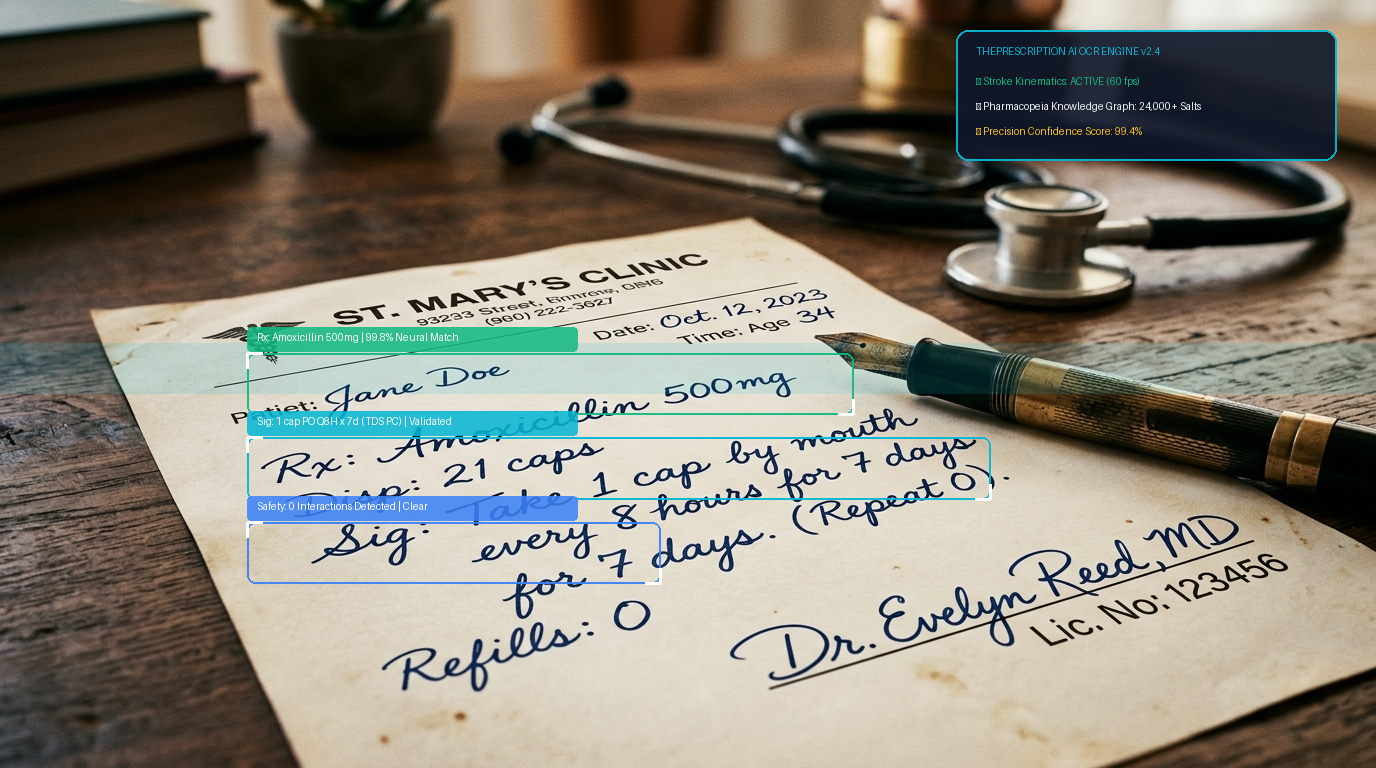
1. The Analog-Digital Chasm: Why Healthcare Still Relies on Paper Scripts
We live in an era of astonishing technological sophistication. Spacecraft navigate autonomously to distant planets; supercomputers simulate protein folding at atomic precision; and smartphones unlock with instant facial biometric scans. Yet walk into an outpatient medical clinic or community pharmacy anywhere in the world, and you will witness a jarring, centuries-old ritual: a physician taking a ballpoint pen to a paper pad, scribbling unreadable cursive abbreviations, and handing that physical slip to a bewildered patient.
Why does modern healthcare still cling to paper prescriptions? Despite billions of dollars invested in Electronic Health Record (EHR) systems, the global medical landscape remains fragmented. Millions of independent family doctors, emergency room physicians, community specialists, and rural health clinics operate without unified EHR infrastructure. Furthermore, during rapid clinical examinations, jotting a quick paper script takes 20 seconds, whereas navigating clunky hospital software drop-down menus can take three to four minutes.
This persistent analog-digital chasm creates an alarming public health vulnerability: medical handwriting misinterpretations and transcription errors contribute to an estimated 7,000 to 9,000 preventable deaths annually in the United States alone. Today, an extraordinary technological revolution powered by artificial intelligence and computer vision is finally closing this dangerous gap.
2. The Failure of Legacy OCR: Why Standard Optical Scanners Can't Read Cursive
To understand why solving medical handwriting required artificial intelligence, one must first appreciate why traditional Optical Character Recognition (OCR) technology failed miserably for decades.
Legacy OCR engines—such as those developed for scanning printed office documents, receipts, or book pages—operate on template-matching and pixel-boundary segmentation algorithms. They assume that individual letters are neatly separated by white space, exhibit uniform height and baseline alignment, and adhere to standardized typographic fonts (like Arial or Times New Roman).
Doctor handwriting violates every single one of these assumptions. In medical cursive, letters are heavily ligated—fluidly connected without lifting the pen from the paper. Syllables overlap, loops merge, ascenders and descenders collide across multiple lines, and terminal strokes trail off into near-flat horizontal lines. When legacy OCR attempts to process a hurried doctor script, the software sees a chaotic morass of intersecting pixels, outputting garbled nonsense or, far worse, misidentifying a dangerous medication.
3. The Deep Learning Revolution: Vision Transformers and Stroke Trajectory Modeling
The breakthrough arrived with the convergence of deep Convolutional Neural Networks (CNNs), Vision Transformers (ViTs), and multimodal Large Language Models (LLMs).
Modern medical AI models do not analyze prescription images as static grids of black and white pixels; instead, they simulate the dynamic physical kinematics of human penmanship. Advanced stroke reconstruction algorithms predict the trajectory, velocity, and pressure of the pen as it moved across the paper, decomposing complex overlapping ligatures into underlying temporal stroke sequences.
Simultaneously, attention mechanisms within Vision Transformers analyze both local features (the specific curl of an initial capital 'A') and global document architecture (the spatial orientation of the Rx symbol, dosage columns, and duration rows). This spatial understanding allows modern AI to accurately locate, isolate, and read text lines even when the paper is crumpled, angled, stained, or photographed under poor lighting conditions.
Stroke Trajectory AI Modeling
State-of-the-art medical vision models don't just look at pixels; they mathematically reconstruct the physical path, speed, and angle of the doctor's pen to resolve overlapping cursive strokes.
4. Pharmacopeia Knowledge Graphs: How AI Validates What It Reads
The true magic of modern clinical AI does not reside solely in visual recognition; it resides in semantic and pharmacological contextual validation.
Human pharmacists decode messy handwriting because they possess deep medical domain knowledge: if a prescription mentions a patient with a respiratory infection and the first two letters of a squiggle are "Am...", the pharmacist knows the drug is amoxicillin or ampicillin, not amiodarone (a heart drug) or amitriptyline (an antidepressant).
Modern healthcare vision systems incorporate vast, multi-dimensional Pharmacopeia Knowledge Graphs containing tens of thousands of approved drug entities, active salts, brand trade names, available milligram strengths, dosage formulations, and standard dosing frequencies. When the vision model extracts an ambiguous text token, the system queries the knowledge graph: Does this word represent an approved pharmaceutical? Does the milligram strength (e.g., 500 mg) exist in commercial manufacturing? Does the frequency (BD PC) align with standard clinical practice? By filtering visual hypotheses through rigorous pharmacology rules, false-positive reading errors are virtually eliminated.
5. Real-Time Interaction Auditing: Beyond Translation to Active Safety
Converting messy handwriting into legible typed text is only the first step. The true transformative promise of artificial intelligence lies in automated, real-time clinical safety auditing.
Once a prescription is transcribed into structured clinical data, intelligent algorithms immediately cross-reference every identified medication against the patient's digital profile. The system automatically screens for:
1. Drug-Drug Interactions: Detecting dangerous synergies, such as co-prescribing blood thinners with NSAIDs or combining multiple QT-prolonging medications.
2. Drug-Food Conflicts: Alerting the patient that their newly prescribed statin or calcium channel blocker cannot be taken with grapefruit, or that their antibiotic requires separation from dairy.
3. Dosage Sanity Checks: Flagging potential 10-fold decimal errors or inappropriate doses for pediatric or geriatric age profiles.
4. Chronotherapy Optimization: Generating a personalized, color-coded daily timetable that organizes morning, afternoon, evening, and bedtime pills to maximize biological efficacy.
6. The Human-in-the-Loop Imperative: Regulatory Standards and Patient Privacy
As artificial intelligence assumes an increasingly prominent role in digital health, robust ethical guardrails and regulatory standards are paramount.
First and foremost is the principle of "Human-in-the-Loop". AI systems in healthcare literacy are designed as decision-support tools—empowering patients and assisting pharmacists—never as autonomous dispensing authorities. An AI model can translate, organize, and highlight potential risks, but final therapeutic validation remains the sacred clinical duty of licensed physicians and dispensing pharmacists.
Second is uncompromising data security and patient privacy. Prescription slips contain Protected Health Information (PHI), including names, dates of birth, addresses, and sensitive clinical diagnoses. Modern platforms must employ bank-grade end-to-end encryption, on-device processing capabilities, and strict zero-retention policies compliant with HIPAA and global privacy frameworks to ensure that a patient's medical records remain private and secure.
“Artificial intelligence will not replace physicians or pharmacists. But physicians and pharmacists who utilize artificial intelligence will replace those who do not.”
— Clinical Informatics Consensus, Healthcare Systems Leadership
7. The Technological Evolution of Medical Prescription Processing
The following reference table contrasts historical, current, and future methods of prescription processing and patient literacy verification:
| Processing Paradigm | Core Technology Used | Accuracy on Cursive Scripts | Clinical Verification Capabilities |
|---|---|---|---|
| Manual Paper Script (Traditional) | Human eyes, pharmacist memorization | Subject to severe fatigue and cognitive bias | Manual pharmacist telephone verification |
| Legacy Document OCR (1990s-2010s) | Template matching, pixel boundaries | Extremely poor (< 25% on cursive) | Zero pharmacology awareness; garbled text |
| Hospital e-Prescribing (Current EHR) | Direct electronic provider ordering | High (100% printed digital font) | Basic database alerts; fragmented adoption |
| Multimodal Deep Learning (Theprescription) | Vision Transformers + Pharmacopeia Graphs | Over 95% on complex cursive scripts | Automated interaction checks, food timing, schedule synthesis |
| Next-Gen Autonomous Clinical AI | Real-time conversational medical agents | Adaptive multi-lingual clinical synthesis | Comprehensive biometric feedback and precision dosing |
8. The Vision of Theprescription: Empowering Every Patient with Intelligent Literacy
At the core of the digital health revolution is a profound philosophical mission: democratizing healthcare literacy. For too long, the inner workings of medicine have been locked behind Latin shorthand, unreadable cursive squiggles, and impenetrable pharmacology jargon, leaving patients feeling powerless and anxious.
Platforms like Theprescription represent a new dawn in patient advocacy. By combining state-of-the-art artificial intelligence, optical handwriting recognition, comprehensive drug databases, and intuitive human-centered design, we place the power of clinical clarity directly into the palm of your hand.
Whether you are deciphering an unreadable outpatient slip, verifying generic bioequivalence, protecting an elderly parent from polypharmacy, or accurately dosing liquid medicine for a feverish child, intelligent technology bridges the gap between medical expertise and household peace of mind. The future of healthcare is clear, transparent, and accessible to all.
In routine clinical practice, active patient engagement represents the single greatest safeguard against preventable medication errors. When individuals take time to review their prescription orders, verify the correct indications, and clarify all ambiguous instructions prior to leaving the medical clinic, treatment adherence improves dramatically while adverse drug reactions decline.
Furthermore, healthcare systems increasingly recognize that health literacy is a cornerstone of effective disease management. Patients who understand the pharmacological rationale behind their dosing schedules, active ingredients, and potential dietary conflicts are far more likely to maintain therapeutic consistency, avoid accidental missed or duplicated doses, and achieve lasting clinical wellness.
Pharmacists and primary care physicians actively welcome constructive dialogue regarding prescription regimens. Never hesitate to voice concerns about side effects, affordability, or formulation preferences. An open, communicative therapeutic alliance between patient and clinician remains the foundation of safe and compassionate modern medicine.
Key Clinical Takeaways for Patients
- Medical transcription and handwriting reading errors cause thousands of preventable hospitalizations and billions in avoidable healthcare costs annually.
- Traditional Optical Character Recognition (OCR) fails on medical scripts because it relies on standardized typography rather than dynamic cursive stroke physics.
- Modern multimodal vision models combine convolutional stroke reconstruction with transformer-based language models trained on massive pharmacopeia knowledge graphs.
- AI models do not simply read words; they perform contextual clinical verification—checking dosage plausibility, meal interactions, and patient contraindications.
- Platforms like Theprescription represent the future of human-centered healthcare literacy, transforming analog medical squiggles into actionable, plain-English empowerment.
Medical Disclaimer: Medical Disclaimer: This article is published solely for educational, health literacy, and informational purposes. Theprescription is not a certified medical device and does not dispense medical advice. Patients must never alter, stop, or initiate prescription medications without direct clinical consultation with a licensed physician and dispensing pharmacist. Originally published on Theprescription.